


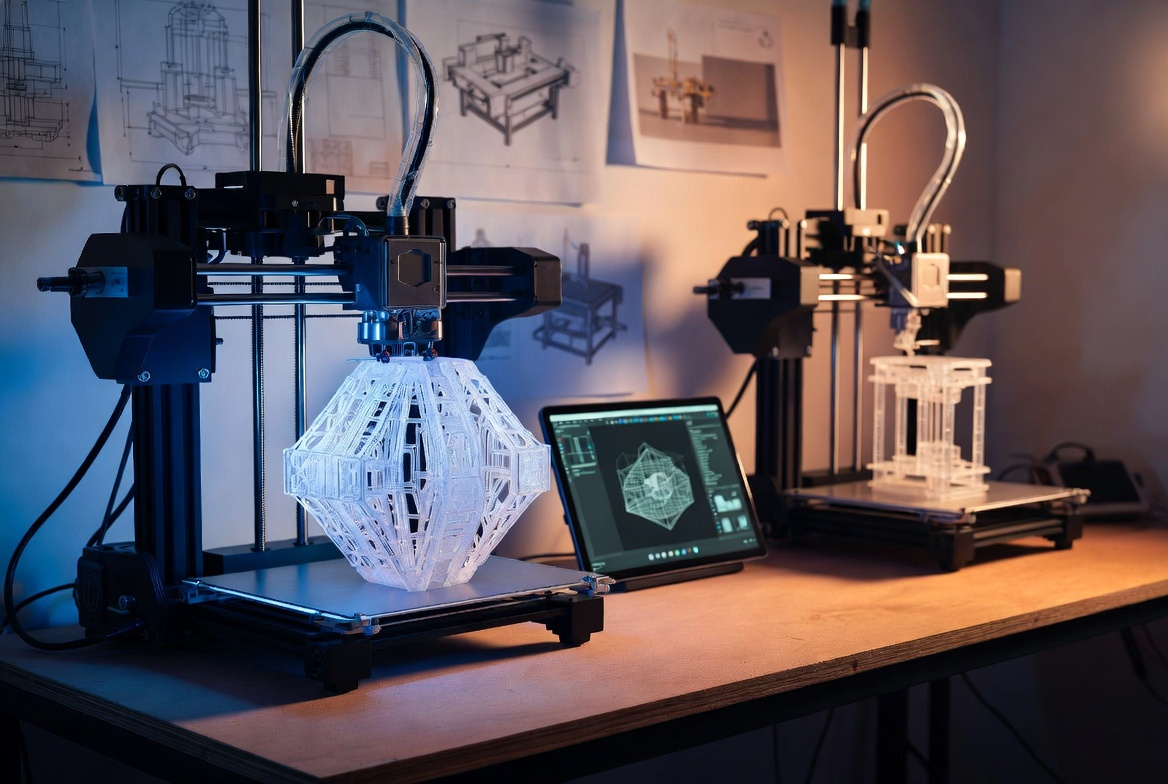
Top 10 3D Printing Innovations to Watch
3D printing had a strange decade. For most of it, the headlines promised one thing — and the actual capabilities delivered something less. Somewhere around 2023, that gap started closing fast.
The global additive manufacturing market is worth roughly $25 billion today and growing 23% a year, pulled by aerospace, medical devices, and consumer products. About 40% of industrial additive output now goes into end-use parts, not prototypes — flipping the 2020 ratio. The shift wasn't one breakthrough. It was a stack of them landing together: AI in design and quality control, materials that can do new tricks, file standards that finally caught up, and consumer-grade hardware safe enough to live on a kitchen counter.
This guide walks through the ten 3D printing innovations actually reshaping manufacturing in 2026 — what they do, who's using them, and which ones reach you first. Where NSF, ISO, NASA, or peer-reviewed research has on-the-record numbers, we cite the source. Where it's our reading of the category, we say so.
What's Driving Innovation in 3D Printing?
Five forces compounding at the same time. None of them is the whole story. Together they explain how fast the technology is changing.
Faster production speeds
Carbon's CLIP technology runs 25 to 100 times faster than older resin printing. Consumer FDM printers now hit 500–600 mm/s with accelerations near 20,000 mm/s². Five years ago, 60 mm/s was considered fast. The bottleneck used to be the machine. Now it's the operator.
Demand for customization
One-size-fits-all manufacturing keeps losing ground in healthcare, footwear, jewelry, and education. Patient-specific implants, custom shoe midsoles, made-to-order rings, classroom anatomy models — none of these scale with injection molding. 3D printing was built for batches of one. That's the structural advantage nothing else has matched.
Sustainability pressures
Subtractive machining wastes up to 90% of a titanium billet as chips. Powder bed fusion recycles 95–98% of unused metal powder for the next print. Companies needing to meet climate commitments find additive easier to justify than ever — life-cycle assessments show 35–50% lower embodied carbon for printed titanium aerospace parts versus machined equivalents. The math finally works.
AI-powered manufacturing
Machine learning is now watching prints in real time, catching defects layer by layer before the bad part finishes. Generative design produces parts 30–70% lighter than what a human engineer would draw. The same algorithms trickle down to home printers as auto-leveling, smart calibration, and text-to-model generation. The wall between industrial and desktop is thinner than it used to be.
Material breakthroughs
Voxel-level color printers address 600,000+ distinct colors per part. High-temperature polymers like PEEK push into aerospace and medical applications. Bio-inks let researchers print living tissue. Shape-memory polymers fold themselves after printing. The materials shelf is wider than it was three years ago — and it keeps growing.
|
THE 60 MM/S BENCHMARK Back in 2005, a consumer FDM printer like the RepRap project's earliest builds was printing at about 15 mm/s. Reaching 60 mm/s by 2015 took a decade of mechanical and electronics work. Reaching 600 mm/s in the next ten years was supposed to be impossible — and then it wasn't. The leap came largely from algorithms borrowed from CNC machining, not from new hardware. The lesson: in 3D printing, software innovation often outruns mechanical innovation. |
Top 10 3D Printing Innovations to Watch
1. AI-Powered 3D Printing Systems

Smart printers don't just lay down material anymore. They think while they work. The biggest shift here isn't generative design — though that gets the press. It's the four less-visible AI capabilities now running on industrial machines and trickling down to consumer hardware.
Real-time defect detection uses convolutional neural networks to compare each printed layer to its intended geometry. A porosity void, a warping edge, a clogged nozzle — the system either corrects on the fly or stops the print before it wastes more material. GE Additive and EOS both ship machines with this baked in.
Predictive maintenance reads the printer's own telemetry — motor currents, bearing temperatures, fan vibration — and flags problems before they cause a failed print. The machine asks for human help before something breaks, instead of after.
Print optimization is where AI changes design itself. Autodesk's Fusion 360 generative tools cut design cycles from weeks to hours and produce parts 30–70% lighter than what engineers draw by hand. Airbus hit 30% mass reduction on aerospace brackets. GM hit 40% on a printed steering knuckle.
Smart calibration removed the last manual hassle from desktop printing — leveling the bed, tuning the temperature, dialing in flow rates. New consumer printers handle all of it in under a minute. For first-time buyers, that's the difference between using the printer for a year and giving up after a week.
2. Bioprinting Human Tissue and Organs

Bioprinting's the most ambitious thing 3D printing can do — and the furthest from showing up in your local hospital. The basic idea: lay down bio-inks (mixes of living cells, hydrogels like gelatin methacryloyl or alginate, and growth factors) layer by layer to build a tissue scaffold. The scaffold gives the structure. The cells, once they settle in, do the actual biological work.
At Wake Forest Institute for Regenerative Medicine, researchers have printed ear cartilage and kidney scaffolds where more than 85% of the cells survive the printing process — a real number, not a marketing one. A Stanford team built an algorithm that maps the vascular trees a thick tissue needs to stay alive, and it runs 200 times faster than older methods. MIT and Northeastern groups are developing elastic hydrogels designed specifically for soft tissue printing.
Pharma testing is where bioprinting already pays its way. Drug companies use printed tissue organoids (mini-organs roughly the size of a pinhead) to test compounds without animal models. Faster results, ethical wins, better predictive data. Pfizer, Roche, and Organovo all built workflows around this.
The transplantation dream is still distant. Once a tissue construct gets thicker than ~200 micrometers, cells in the middle can't get oxygen by diffusion alone — they need their own blood supply. Solve vascularization, and a generation of regenerative therapies opens up. The ethical questions are catching up too: who owns a printed organ, can patients self-engineer tissues, what happens to the donor system. If you want the deeper science, this peer-reviewed paper on bioprinted tissue scaffolds is a good place to start.
|
THE 200-MICROMETER WALL Two hundred micrometers is roughly twice the thickness of a human hair. Past that depth, oxygen and nutrients can't reach a printed cell by diffusion alone. The cells starve in the middle of the construct. That's why bioprinted ear cartilage and skin scaffolds work in research today — they're thin — and bioprinted kidneys and livers don't. The fix isn't a faster printer. It's a way to print working capillaries at the same time you print the tissue around them. |
3. 4D Printing Technology

The "4D" name throws people off. There's no fourth spatial dimension. The fourth dimension is time. A 4D-printed object changes shape after it's printed, in response to a trigger: heat, water, light, or pressure.
MIT's Self-Assembly Lab, run by Skylar Tibbits, pioneered the field around 2013. Shape-memory polymers and hydrogels were the early materials. Print a flat tile, drop it in water, and it folds into a 3D structure. The original demos looked like magic. They worked.
Today the applications are practical. Aerospace uses 4D-printed deployables for satellite structures — print flat for tight launch packaging, then let solar heat trigger the unfolding in orbit. Medical research uses self-expanding stents that fit through a small incision and expand to fill the artery. Smart textiles change ventilation in response to temperature. Soft robots that fold themselves into walking configurations are showing up in research labs.
The big constraints: 4D materials cost 10 to 50 times standard 3D printing materials, and the design tools are still rough compared to mainstream CAD. Most 4D work happens in research labs, not production lines. But if the materials economics improve over the next five years, 4D printing could become the default for any object that needs to deploy, expand, or adapt after manufacturing.
4. Sustainable and Recyclable Printing Materials

Plastic was the original 3D printing problem. ABS off-gases. PLA breaks down slowly. Both go to landfills. The industry's been quietly fixing this for a decade — it just hasn't made loud headlines.
PLA itself is now widely available as recycled filament. Companies like ReFil and Filabot sell filament made from post-consumer plastic — water bottles, food packaging, even old failed prints. Quality's close to virgin material. Cost is similar or lower.
Plant-based and biodegradable resins are the next wave. Algae-based bioplastics, soy-based photopolymers, and mycelium composites have all moved from research to small commercial production. They print well enough for prototype work and compost at industrial facilities.
On the metal side, powder bed fusion machines recycle 95–98% of unused metal powder for the next print. Subtractive machining can waste up to 90% of a titanium billet. Life-cycle assessments show printed titanium aerospace parts have 35–50% lower embodied carbon than machined equivalents.
Here's the catch though. Injection molding still wins on carbon per piece at production volumes above 10,000 units. Additive sustainability is strongest where it always was — complex geometries, low-to-medium volumes, parts that benefit from weight reduction over their service life. The marketing pitch that 3D printing is universally green isn't quite right yet. For the full data, see peer-reviewed comparisons of additive vs. conventional manufacturing.
5. Large-Scale Construction 3D Printing

Concrete printing moved past demo projects in 2022. It's now building permitted, occupied houses. ICON's Vulcan system prints load-bearing concrete walls for residential homes in Austin, Texas, with structural printing times of 24 to 48 hours per house. The Wolf Ranch development outside Austin includes more than 100 occupied printed homes.
Mighty Buildings has done permitted construction in California. Habitat for Humanity has used printed walls on approved single-family builds. Material costs for the structural shell can run 30 to 40% below conventional framing for the same square footage.
The affordable housing angle is real. A printed shell costs less, goes up faster, and uses fewer skilled tradespeople than conventional framing. In markets with severe labor shortages — Austin, Phoenix, parts of Florida — this is starting to pencil out. Not "build a $50,000 house" levels of cheap. But $20,000–$50,000 below comparable framed construction is real money.
Timeline savings are partial though. The walls go up in 24–48 hours. Plumbing, electrical, finish work, roofing, and HVAC still take traditional time — about 4 to 6 months from breaking ground to move-in. The savings are real but not magical.
None of this would work without the regulatory side keeping up. ISO/ASTM 52939:2023 sets quality-assurance rules that give building departments a framework for approving printed homes instead of treating each one as a one-off experiment. Without that standard, the whole sector would have stalled.
6. Nano 3D Printing

Nano printing operates at scales most people can't see — features down to 100 nanometers. That's smaller than a virus. It uses two-photon polymerization (2PP): a femtosecond laser that cures resin only where two photons converge simultaneously inside a vat. Nothing happens anywhere else.
Nanoscribe is the dominant name. Their Photonic Professional GT2 machines now run in over 1,500 research labs and a growing number of medical device manufacturers. UpNano, BMF, and Microlight 3D are pushing the field forward too.
Applications cluster in four areas. Micro-optics — printed lens arrays smaller than a grain of rice that ship inside endoscopes and AR glasses. Lab-on-chip devices — entire diagnostic platforms with channels narrower than human hair. MEMS — micro-electromechanical systems for accelerometers and pressure sensors. Drug delivery — microneedle patches that deliver vaccines without the standard injection pain.
The cost is the catch. A Nanoscribe printer runs $300,000 to $500,000, and a single print might take 24 hours for a part smaller than a sesame seed. This isn't trickling down to home printers. It's an industrial tool for industrial problems — but it enables a whole class of products that were physically impossible to manufacture before. The downstream impact shows up in medical devices, semiconductors, and optics that wouldn't otherwise exist.
7. Multi-Material 3D Printing

Single-material parts were the original constraint. A printed object that needed both a rigid skeleton and a soft grip had to be printed twice and glued. Multi-material printing solved this in two different ways.
Multi-nozzle FDM is the more accessible path. Printers like the Bambu Lab X1C, Prusa XL, and similar systems place up to seven different materials in a single object — a rigid PLA frame, a flexible TPU gasket, a soluble support material, a color accent — all in one print run. Fully assembled functional parts come off the bed.
Voxel-level color mixing takes it further. Industrial photopolymer machines use CMYK ink systems to address more than 600,000 distinct colors per print, producing parts with gradient transitions that look like injection-molded consumer products. Anatomical models, prosthetic shells, and prop replicas have been the early commercial use cases.
The hot-end tool changer fixed multi-material printing's worst inefficiency — the purge tower. Bambu Lab's VORTEK system swaps entire hot-end assemblies wirelessly, eliminating the wasted material that used to exceed the actual print weight on complex multi-color parts.
For makers and small studios, multi-material printers cost noticeably more — but the time savings on assembly often pay back the premium within months. For mass production, this is the technology that finally lets 3D printing compete with injection molding on integrated functional parts.
8. Metal Additive Manufacturing Advancements

Metal AM is where 3D printing finally proved it could ship safety-critical parts at scale. GE Aviation's LEAP engine fuel nozzle consolidates 20 separately manufactured parts into a single printed component — 25% lighter, 5× longer service life. Over 100,000 nozzles are in commercial aviation service today.
Lockheed Martin uses Sciaky's electron beam additive manufacturing to print titanium satellite fuel-tank domes up to six meters tall. Boeing's 777X engine carries 300+ printed parts, most consolidated assemblies that used to be three or four bolted-together pieces.
Automotive's moving faster than people realize. BMW prints aluminum brake calipers for the M850i. Bugatti prints titanium brake calipers for the Chiron. Czinger Vehicles built an entire 21C hypercar around a printed structural chassis. The cost math works on low-volume premium vehicles. As metal printer prices keep dropping (industrial machines now run $200,000–$800,000, down from $1.5M–$2M five years ago), expect this to spread to mass-market models within five years.
Lightweight metals are the through-line. Every kilogram off an aircraft saves roughly 12 metric tons of jet fuel over its service life. Every kilogram off an EV adds a fraction of a mile of range. Engineers used to leave weight on the part because they couldn't machine the optimized shape. Additive manufacturing removed the constraint.
|
WHY GE KEEPS MENTIONING ONE NOZZLE GE Aviation's LEAP fuel nozzle gets cited so often because it solves four problems at once — weight (25% lighter), durability (5× longer service life), part count (20 → 1), and manufacturing cost. Most aerospace "breakthrough" parts only fix one of those. The nozzle's also the highest-volume printed engine component in commercial aviation, with over 100,000 units in service. When you fly a 737 MAX or A320neo, there are 19 of them in each engine, every flight. |
9. Cloud-Based Distributed Manufacturing

Centralized factories are a 19th-century pattern. Cloud-based distributed manufacturing flips it: you upload a file, the platform routes the job to the nearest qualified printer, and the part ships from there. No warehouse. No shipping a part across continents. No 8-week lead time.
Protolabs (which acquired 3D Hubs in 2021) and Xometry both run networks with thousands of distributed printers across plastic, metal, and elastomer processes. Upload a CAD file in the morning, get parts shipped from a nearby facility within days. For replacement parts, low-volume manufacturing, and on-demand spares, this beats traditional supply chains on speed and often on cost.
NASA pushed the concept hardest. Made In Space (now Redwire) has a 3D printer on the International Space Station that prints tools and replacement parts on demand. No more waiting six months for a launch window to receive a wrench from Earth. See NASA's documentation on additive manufacturing for crewed spaceflight for the spaceflight angle.
The supply-chain implications are bigger than they look. Spare parts for industrial equipment, military vehicles, medical devices — anything that needs occasional replacement parts — can be stored as a CAD file instead of a physical warehouse. Print on demand, ship locally. Less inventory tied up in capital. Less risk of obsolete parts.
The catch: quality control across distributed networks is harder. The platform needs strict standardization on materials, calibration, and post-processing. Not every print job's suitable for distributed manufacturing. But for the ones that are, this is a fundamental rethink of how physical goods move.
10. Personalized Consumer Product Printing

This is where 3D printing finally reached you. Personalized consumer products aren't a future promise anymore — they're already in shoes, dental aligners, hearing aids, jewelry, and increasingly, the family kitchen.
Adidas produces midsole lattices for the Futurecraft 4D and 4DFWD using Carbon's Digital Light Synthesis. Each midsole is tuned to a specific runner's biomechanics. New Balance's TripleCell platform uses similar technology. Brooks ships custom-fitted insoles printed from a customer's foot scan.
Healthcare is the quiet giant. Over 99% of hearing aid shells are now 3D printed. Invisalign and competing aligner brands print roughly 500,000 aligners per day. Dental crowns, surgical guides, custom prosthetics — all routine work for 3D printers now.
Jewelry's moved on-demand. Shapeways lets customers customize rings, pendants, and earrings, then prints in materials from sterling silver to titanium. The economics work because nothing prints until someone orders.
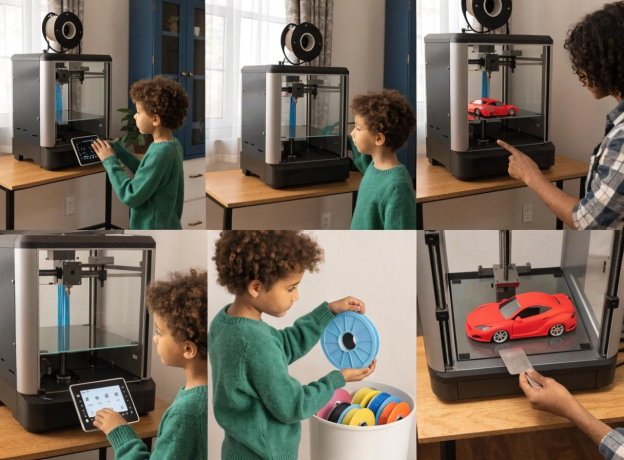
Home use is the newest layer. The same AI-assisted design, automatic calibration, and enclosed safer hardware that made industrial AM viable produced a generation of family-friendly printers a child can operate with adult setup help.
AOSEED's family creativity platform is one example of how this consumer layer matured. The hardware's fully enclosed, the design happens on a tablet through a guided app with AI-assisted modeling tools, and the project library updates weekly — so the printer keeps getting used after the first month. Families weighing first-time setup can compare the lineup of kid-friendly 3D printers built for home use by age and project complexity, with a guided STEM 3D printer for older kids and teens sitting at the more advanced end of the range.
K-12 use has scaled in parallel. AOSEED hardware is in over 5,000 schools and reaches more than a million students, mostly through guided STEM projects that integrate the printer with broader curriculum work. The same enclosed-and-app-led design that works for a family kitchen works for a middle school classroom.
|
THE KITCHEN-COUNTER SHIFT The most important 3D printing innovation for most readers isn't bioprinting or hypersonic engine parts. It's the slow, accumulated work that took a million-dollar industrial process and shrank it into something a family can run on a Saturday afternoon — and then keep running every weekend after. That's the story this whole list adds up to. |
Industries Most Impacted by 3D Printing Innovations
The pattern across industries is the same. 3D printing wins where complexity, customization, or weight reduction beats volume economics. Six sectors moved fastest.
|
Industry |
Key Innovation Applied |
Notable Examples |
|
Healthcare |
Bioprinting + patient-specific implants |
Wake Forest Institute ear cartilage; 1,000+ FDA-cleared printed medical devices since 2010 |
|
Aerospace |
Lightweight metal parts + assembly consolidation |
GE LEAP fuel nozzle (20 parts → 1); Boeing 777X with 300+ printed components |
|
Automotive |
Rapid prototyping + production metal parts |
BMW M850i aluminum brake calipers; Czinger 21C hypercar printed chassis |
|
Construction |
Large-format concrete printing |
ICON Wolf Ranch (100+ permitted homes); Mighty Buildings California permits |
|
Consumer Goods |
Personalization at production scale |
Adidas Futurecraft 4D; 99% of hearing aid shells; 500,000+ daily printed aligners |
|
Education |
Affordable prototyping + STEM curricula |
AOSEED in 5,000+ schools reaching 1M+ students; Penn State innovation hubs |
What ties the list: every one of these is doing something injection molding or subtractive machining couldn't. Healthcare needs patient-specific shapes. Aerospace needs lightweight complexity. Construction needs design freedom. Consumer goods need personalization at scale. Education needs cheap iteration. Automotive needs parts that don't yet exist in production. 3D printing isn't competing with traditional methods — it's filling gaps traditional methods never could.
Challenges Facing Advanced 3D Printing
Five real constraints. The technology isn't magic, and the marketing pitch sometimes runs ahead of the engineering reality.
High equipment costs
Industrial metal printers run $200,000–$800,000. Even with prices dropping from $1.5M–$2M five years ago, that's still beyond most small manufacturers. Consumer printers are cheap. Production-grade machines aren't. The capital math gates entry.
Regulatory concerns
Healthcare and aerospace need rigorous certification. The FDA has cleared 1,000+ printed medical devices since 2010, but each new application is a new approval process. Building departments are still learning how to evaluate printed homes. Drug companies haven't gotten clearance for bioprinted tissues at clinical scale. Regulation lags innovation, and there's no clean way around it.
Material limitations
Despite progress, the printable material library is still narrower than traditional manufacturing. Many high-performance metals, engineering plastics, and composites either can't be printed yet or print poorly. The "I can print anything" pitch isn't accurate. It will get closer over the next decade, but the gap is real today.
Speed scalability
Even with CLIP and high-speed FDM, 3D printing doesn't beat injection molding above ~10,000 units. For mass production of identical parts, traditional methods still win on cost and speed per piece. Additive scales horizontally (more machines) better than vertically (faster machines), which has its own economics.
Intellectual property issues
A 3D model is a file. Files are infinitely copyable. The original 3D printing patents from the 1980s have all expired, and design IP is harder to enforce when anyone with a printer can replicate the part. Watermarking, blockchain authentication, and DRM-style controls are all being tried. None has solved the problem yet.
The Future of 3D Printing Innovation
Forecasting tech is mostly humbling. But the patterns from the last decade suggest five things worth watching over the next five.
AI integration deepens
Generative design moves from "engineer with AI assistance" to "AI with engineer review." Text-to-CAD becomes standard. Real-time quality control goes universal — across consumer printers, not just industrial machines. The bar for "can I design this myself" drops dramatically. A nine-year-old with a tablet becomes a producer, not just a consumer.
Fully autonomous manufacturing
Lights-out factories already exist for some processes — semiconductors, certain CNC operations. Additive manufacturing fits the same model. Load powder, hit print, walk away for 48 hours. Expect more factories that run overnight without human intervention, with cloud monitoring instead of on-site operators.
Space manufacturing
NASA's ISS printer (Made In Space / Redwire) has been a demo for years. Production-scale space manufacturing — lunar habitats from regolith concrete, on-orbit satellite construction, asteroid mining tools — moves from research to early commercial deployment by 2030. Material constraints in space favor additive heavily, because every kilogram launched still costs roughly $10,000.
Sustainable factories
Closed-loop material systems where unused powder, failed prints, and waste material all get recycled within the same facility. Some industrial AM facilities already approach 95% material reuse. The next step: factories that source feedstock locally from recycled streams, eliminating the carbon cost of virgin material shipping.
Consumer-level mass adoption
This is the slowest curve but the most consequential. When 3D printers are as common in homes as inkjet printers were in 2005 — and as easy to use as smartphones — the supply-chain implications cascade across retail, manufacturing, and consumer behavior. We're not there yet. But we're closer than we were three years ago, and the AOSEED-style enclosed printers showing up in kitchens and classrooms are what's driving that curve.
Conclusion: 3D Printing's Quiet Maturity
Three years from now, 3D printing won't be a story about "the future" anymore. It's already here. It's just unevenly distributed.
Companies adopting now are building competitive moats. Aerospace primes that print consolidated parts at half the weight have a permanent cost and performance advantage over those still bolting assemblies together. Healthcare practices that print patient-specific implants beat catalog-implant providers on outcomes. Custom-product brands that ship made-to-order in days outcompete inventory-heavy traditional retailers. The technology rewards early movers.
For families and educators, the practical innovation is the one sitting in a fully enclosed enclosure on a kitchen counter or in a classroom corner. AI-assisted design, weekly-updated project libraries, and safe hardware turned a million-dollar industrial process into something an 11-year-old can run on a Saturday afternoon. The technology arrived for consumers. The interesting question — and the one that defines the next five years — is what gets made first, and who gets to make it.
Three innovations on this list deserve the closest attention: AI-driven design (because it changes who can use 3D printing at all), bioprinting (because solved vascularization changes regenerative medicine completely), and personalized consumer products (because that's where you'll first encounter all of it). The other seven are quantitative improvements on predictable curves. These three could be qualitative changes.
The technology has already arrived. The next chapter is about what you do with it.
FAQs
What are the latest breakthroughs in 3D printing?
The 2025–2026 breakthroughs cluster around four areas: speed, intelligence, materials, and standards. Carbon's Continuous Liquid Interface Production runs photopolymer printers 25 to 100 times faster than older resin methods. Multi-laser metal powder bed fusion systems use 4 to 12 lasers in parallel to cut throughput times by 200 to 400%. AI-driven generative design produces parts 30 to 70% lighter than solid equivalents. And AI defect detection now runs layer-by-layer in real time on industrial machines.
What are some innovative uses of 3D printing?
The catalog gets wider every year. Patient-specific titanium implants now reach 95 to 98% osseointegration rates, beating conventional implant benchmarks. Adidas produces midsole lattices using Carbon's Digital Light Synthesis process. ICON has built more than 100 permitted, occupied printed homes outside Austin. Restor3D prints procedure-specific surgical instruments. ZooTampa printed a biocompatible replacement beak for a great hornbill with cancer.
Schools print custom lab fixtures, anatomy models, and student-designed objects. For families wanting a curated set of starter ideas, the AOSEED Learning Center hosts beginner 3D printing project guides organized by age and skill level. Practical tip: start with one project that solves a problem you already have at home — a replacement appliance knob, a cable organizer, a custom phone stand — before printing anything decorative.
When was 3D printing invented?
3D printing was invented in 1983 by Chuck Hull, who developed stereolithography (SLA) and filed the first additive manufacturing patent in 1984. He went on to co-found 3D Systems Corporation, which still operates today. Other foundational methods followed quickly: selective laser sintering came out of the University of Texas in the late 1980s, and fused deposition modeling was developed by S. Scott Crump, who co-founded Stratasys in 1989.
What are the 7 main types of 3D printing?
The seven categories standardized by ISO and ASTM are material extrusion (FDM), vat photopolymerization (SLA and DLP), powder bed fusion (SLS for plastics, SLM and DMLS for metals), material jetting (such as PolyJet and MultiJet), binder jetting, sheet lamination, and directed energy deposition. Each fits a different combination of material, accuracy, and scale.
FDM dominates consumer printing because of low filament cost and forgiving hardware. SLA produces higher detail for jewelry and dental work. Metal powder bed fusion handles aerospace and medical implants. Practical tip when comparing processes: match the technology to how the part will fail under load, not just to how it should look — interlayer adhesion behaves very differently across these seven categories.
What is the most useful thing to 3D print at home?
The most useful home prints solve a specific problem you already had this week. Common winners include drawer dividers, cable clips, vacuum-cleaner adapter sleeves, eyeglass-frame hinges, replacement appliance knobs, kid-safe nightlight diffusers, and toy parts that have broken. For families with children, game pieces, puzzles, marble runs, and craft templates tend to attract the most repeat use.
What was the first 3D printed item?
Chuck Hull is generally credited with the first 3D printed object: a small eye-wash cup printed on his prototype stereolithography apparatus in 1983 at Ultra Violet Products. It was simple — a cylindrical shape with thin walls — but it proved that a digital model could become a physical object by curing photopolymer one layer at a time.
Is it legal to 3D print a house?
Yes, in most U.S. jurisdictions and many other countries, but printed homes have to meet local building codes, permitting requirements, and inspection rules like any other structure. ICON has built permitted, occupied homes in Texas. Mighty Buildings has done the same in California. Habitat for Humanity has used printed walls on approved residential projects.
How is 3D printing being used in education?
3D printing has shifted in K–12 and higher education from "the school has one printer in the library" to integrated curriculum across STEM, art, biology, and history. Universities like Penn State have built dedicated innovation hubs. K–12 classrooms use printers for hands-on math (geometric solids and tessellations), biology (anatomy models, cell structures), and history (replica artifacts and architecture models).
Sources
- U.S. National Science Foundation — 3D Printing: Fabricating the Future: Used for NSF's 40-year history of additive manufacturing research, foundational R&D timeline, and government investment context.
- NIH PMC — 3D Bioprinting: Current Advances in Tissue Engineering— Used for Peer-reviewed bioprinting research, tissue scaffold cell viability rates, and the vascular network challenge in printed organs.
- International Organization for Standardization — ISO/IEC 25422:2025 — 3MF Format Specification — Used for The 2025 international standardization of the 3MF file format replacing STL, and what changed in industry data exchange.
- Formlabs — 25 Unexpected 3D Printing Use Cases — Used for Documented real-world 3D printing applications across automotive, medical, consumer, education, and art restoration sectors.




You may also like
Further reading

3D Printer Unclog Nozzle Techniques: Troubleshooting Guide
Do 3D Printers Use a Lot of Electricity? Facts & Figures

How Much Does a 3D Printer Cost? (Total Ownership Cost)


